
America 250 Historical Driving Tour | Indian Mill
Stop #3 | Address: 7417 Co. Hwy. 47, Upper Sandusky
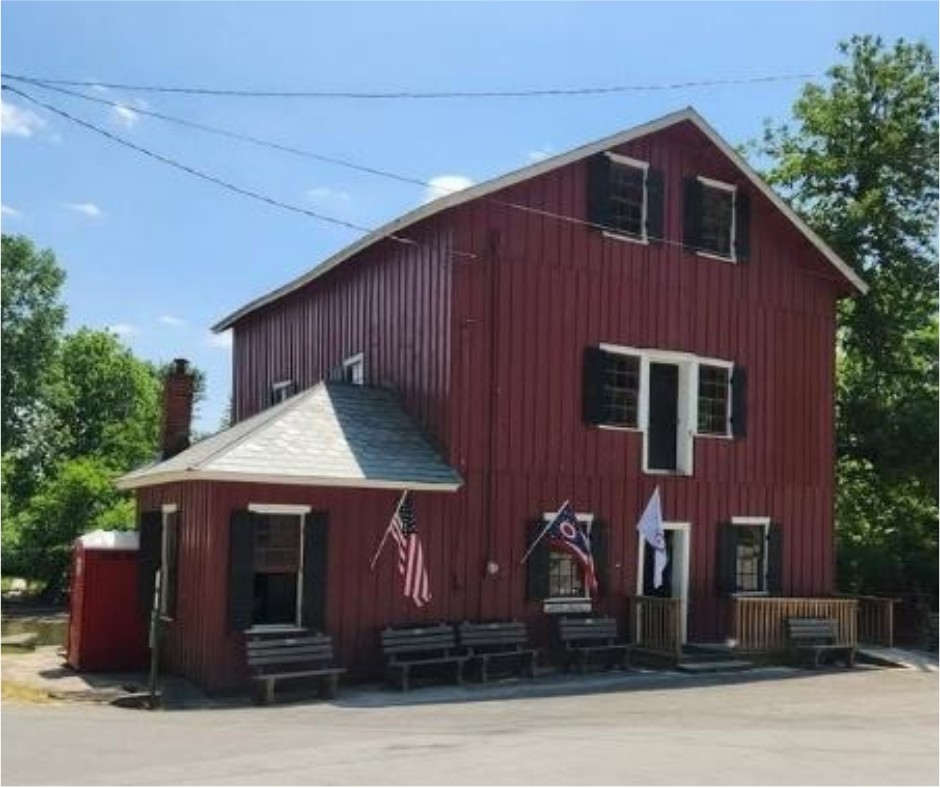
Just northwest of Upper Sandusky, along the scenic Sandusky River is the Indian Mill. Built in 1861, the mill is the nation’s first educational museum of milling in its original structure. The mill ceased operations in 1941, and ownership was transferred to the Ohio History Connection.
When the War of 1812 ended, members of the Wyandotte tribe settled near modern-day Upper Sandusky. Along with them was a group of African Americans—both free blacks and fugitives from slavery—who also settled nearby. The Wyandottes, who’d always been farmers, worked with the African Americans, and the African Americans in turn worked with them. Part of this intermingling led to some of the Wyandottes accepting Christianity and forsaking their customs. This in turn led to limited perks granted by the government, including federal money to build a mill.
As a reward for the loyalty the Wyandottes showed in supporting the Americans during the War of 1812, Article 10 of the Treaty of the Rapids of the Miami of Lake Erie (signed in 1817) called for a sawmill and a grist mill to be erected by the United States Government for the use of the Wyandottes. By 1820, a flour mill, dam and sawmill were constructed on the banks of the Sandusky River. These mills provided important services for the Wyandotte farmers as well as the African Americans living in the area. They were able to process their harvests and turn logs into timber to build their homes. However, under pressure from many white settlers who lived in the area surrounding the Wyandotte reservation, the federal government decided to permanently move the Wyandottes out of Ohio. In 1843, the last of the Wyandottes left the area.
Following the removal of the Wyandottes, these mills fell into disrepair and were abandoned and purchased by George Myers in 1848. He operated them until the current three-story mill was rebuilt with original materials on the present site by Lewis Rummel in 1861. The new mill was powered by three water-powered turbines made by the James Leffel & Co. of Springfield, Ohio. The mill has been owned by various people over the years and was donated to by the Ohio History Connection by the Walton Family in the mid-1950s. The mill was cleaned, restored and formally opened to the public in 1968 as the first educational museum of milling in the United States in a mill still in its original location.
Many exhibits are placed around the original mill machinery. A Leffel Turbine, along with the old stone burrs, bolting chests, and elevators are still visible in their original locations. The restored miller’s office displays historic artifacts related to the history of milling in the nineteenth and early twentieth centuries. Indian Mill is currently managed locally by the Wyandot County Archaeological & Historical Society.
Mill location: 7417 County Highway 47, Upper Sandusky, Ohio 43351
GPS Location: 40.8631119°N, -83.2540863°W
About “Tracking the Troops, Tippecanoe & Perry, Too!” This driving tour is a five-county collaborative project with Wyandot, Seneca, Sandusky, Wood and Ottawa counties that takes you on a self-guided driving tour following the military trail of General William Henry Harrison during the War of 1812. Harrison would later become the ninth president of the United States and has the shortest presidency, dying from pneumonia one month after having taken the oath of office.


